UAE eInvoicing is no longer something businesses can leave on the "we'll deal with it later" list. The country's Electronic Invoicing System is moving into implementation, and businesses need to understand not just when eInvoicing becomes mandatory, but how their invoices will actually move from their accounting system to customers and the Federal Tax Authority (FTA).
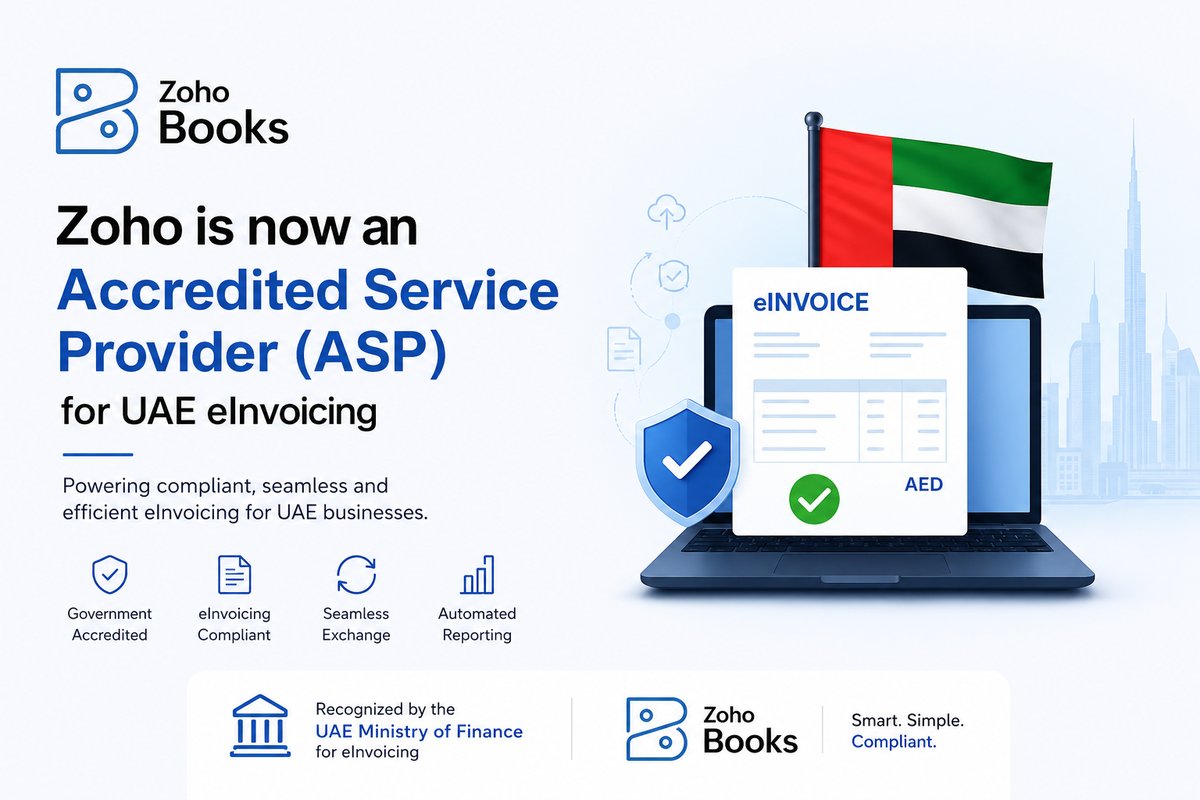
For businesses already using Zoho Books, Zoho Finance, or other Zoho applications, there's an important development: Zoho Software Trading LLC is officially listed by the UAE Ministry of Finance as an Accredited Service Provider (ASP) for UAE eInvoicing — accreditation number 121988, confirmed directly on the Ministry's official registry.
This matters because UAE businesses covered by the eInvoicing mandate must exchange compliant electronic invoices through an Accredited Service Provider. Here's what actually changes for a Zoho user, when your business needs to comply, and what to start doing today — without the technical jargon.
What Is UAE eInvoicing, Really?
Many businesses hear "electronic invoicing" and assume it means emailing a PDF. It doesn't. Under the UAE Electronic Invoicing System, an eInvoice is structured invoice data that can be electronically issued, exchanged, processed, and reported. A PDF, Word document, scanned invoice, or emailed image is not, by itself, an eInvoice under the new system.
| Traditional Process | UAE eInvoicing |
|---|
| Create invoice → save as PDF → email it → customer opens it → customer manually re-enters the data | Accounting/ERP system creates the transaction → structured data passes through an Accredited Service Provider → validated and exchanged electronically → tax data reported automatically |
The direction is clear: invoicing is moving from human-to-human toward machine-to-machine.
What Is an Accredited Service Provider (ASP)?
An Accredited Service Provider is a company authorised under the UAE eInvoicing framework to facilitate compliant electronic invoice exchange. The ASP sits between your accounting/ERP system and the UAE eInvoicing network, handling:
- Validating invoice information
- Converting data into the required UAE eInvoice format where necessary
- Transmitting electronic invoices
- Communicating with the buyer's ASP
- Reporting the required tax data
- Returning electronic status information
Businesses cannot simply generate an XML file themselves and call it an eInvoice — the accredited network is a fundamental part of the system.
Zoho Is Now an Accredited Service Provider — Why That Matters
For a business already running quotations, sales orders, invoices, credit notes, and VAT records inside Zoho Books, having accounting and eInvoicing capability closely connected removes a layer of complexity. Without it, a business might need a separate provider or middleware layer to move invoice data from its accounting system into the UAE eInvoicing network — another integration, another subscription, another place for something to go wrong.
The objective for any business owner should be simple: create the transaction correctly once, and let the technology handle as much of the compliance process as possible. That's where an integrated ASP relationship becomes genuinely valuable.
How UAE eInvoicing Actually Works
Say Company A sells AED 10,000 of goods to Company B. Here's the flow, known as the 5-Corner Model:
- Corner 1 — Supplier: Company A prepares the invoice in its accounting/ERP system.
- Corner 2 — Supplier's ASP: The invoice is sent to Company A's ASP, which validates and converts it into the UAE-standard XML format.
- Corner 3 — Buyer's ASP: Company A's ASP transmits the electronic invoice to Company B's ASP.
- Corner 4 — Buyer: The validated invoice is delivered to Company B.
- Corner 5 — Government platform: The required tax data is reported electronically as part of the process.
Electronic status messages travel through the network throughout, so both parties know whether processing and reporting succeeded — the business user shouldn't need to think about the technical messages moving behind the scenes.
Understanding Peppol and PINT AE
The UAE framework is built on Peppol, an internationally recognised standard for electronic document exchange. Think of it like telecommunications — you don't need the same mobile operator as the person you're calling, because networks communicate through common standards. Your supplier might use one accredited provider and you might use another; the systems still communicate through the shared framework.
PINT AE is the UAE-specific implementation specification for structured electronic invoice data within that Peppol environment. Your sales staff don't need to become XML experts, but your accounting and ERP systems need to supply the required information correctly — which is exactly why clean master data becomes critical before your mandatory date arrives.
UAE eInvoicing Deadlines
The UAE is rolling this out in phases based on annual revenue. Always verify your exact obligations against the latest Ministry of Finance rules, as implementation requirements can be amended.
| Business Category | Appoint an ASP By | Mandatory Implementation |
|---|
| Revenue ≥ AED 50 million | 30 October 2026 | 1 January 2027 |
| Revenue below AED 50 million | 31 March 2027 | 1 July 2027 |
| UAE Government Entities | 31 March 2027 | 1 October 2027 |
The UAE also began its pilot programme on 1 July 2026 with selected taxpayers.
One important clarification: the AED 50 million threshold determines your implementation phase, not a permanent exemption. A business with AED 2 million revenue shouldn't think "we're below the threshold, so this doesn't apply to us" — the correct read is "we're in the later phase, so we have more time to prepare."
Common Misconceptions, Cleared Up
Is a PDF invoice an eInvoice?
No. A PDF may be electronic in the everyday sense, but it isn't structured electronic data for the purposes of the UAE Electronic Invoicing System. The Ministry of Finance specifically distinguishes structured eInvoices from PDFs, Word documents, images, scanned invoices, and emails.
Will businesses still be able to print invoices?
Yes — eInvoicing changes the legally relevant electronic exchange process, not whether humans can see a readable invoice. What changes is that a paper or PDF invoice alone is no longer sufficient once your business falls within the mandatory regime; the structured electronic data becomes the legally important part of the transaction.
Does eInvoicing replace VAT returns?
No. eInvoicing provides structured transaction data through the prescribed electronic system, but VAT returns remain a separate compliance obligation unless the authorities announce otherwise.
Is eInvoicing only for VAT-registered companies?
Not necessarily the same scope. eInvoicing obligations are governed by the Electronic Invoicing System rules, while VAT registration is governed by separate tax rules — don't assume being outside VAT registration automatically means being outside eInvoicing.
I Already Use Zoho Books — What Should I Do Now?
Don't panic, and don't rebuild your accounting system unnecessarily. Start with your data:
- Customer master data — verify names, addresses, TRNs, and other required identifiers
- Company information — confirm your legal entity details match official records
- VAT configuration — review VAT treatments, tax rates, and transaction classifications
- Item master — clean up product/service descriptions, units, and tax classifications
- Credit-note procedures — under eInvoicing, correcting an invoice isn't as simple as editing an old PDF; your team needs a proper correction process
- User permissions — decide who can create, approve, modify, and submit financial transactions
Good eInvoicing starts with good accounting data — not the other way around.
Do I Need to Switch From Zoho Books?
For businesses already on Zoho, ASP accreditation gives a strong reason to investigate the native Zoho route before considering a full system change. Switching purely because of eInvoicing can create unnecessary disruption if your existing platform can support your compliance requirements. Before deciding anything, ask:
- Is our current Zoho setup suitable for UAE eInvoicing?
- What configuration changes will be required?
- Which Zoho application or subscription provides the functionality we need?
- How will ASP onboarding actually work for us?
- What additional fees, if any, apply?
- Do our existing customisations and integrations stay compatible?
- Are all our required transaction types supported?
Make the decision based on your actual workflow, not marketing headlines. And if you're running a different ERP altogether and want Zoho's ASP capability, the real question is whether your ERP can integrate with the selected ASP and supply the required data — that calls for a proper integration assessment, not an assumption that you need to replace your ERP.
Interoperability: Your Customer Doesn't Need to Use Zoho
The whole point of the UAE's Peppol-based model is interoperability. Your company doesn't need to use the same ASP as your customers — a supplier on ASP A can exchange invoices with a buyer on ASP B through the shared standards. Your business can run on Zoho while a customer runs on a completely different ERP or accounting platform, and the ASP/Peppol framework handles the exchange between you.
What Happens to Credit Notes and Corrections?
Credit notes are a core part of the UAE Electronic Invoicing System. If a transaction needs to be reduced or cancelled — a return, refund, pricing correction, or other qualifying adjustment — the appropriate electronic credit note must be processed through the eInvoicing system once your obligations apply. Staff should not simply delete or overwrite issued invoices; this is exactly why internal processes need reviewing before implementation, not after.
Your UAE eInvoicing Preparation Checklist
Don't wait for the mandatory date. A sensible plan looks like this:
- Confirm your implementation phase based on revenue category and applicable deadline
- Review your accounting system and how it will support UAE eInvoicing
- Select your ASP — if you're already a Zoho customer, Zoho's accreditation makes it an obvious one to evaluate
- Clean customer records — TRNs, legal names, addresses, identifiers
- Clean item records — descriptions, units, pricing, VAT treatments
- Review invoice workflows — who creates, approves, sends, and corrects invoices
- Check integrations — CRM, POS, inventory, eCommerce, payment gateways, procurement platforms
- Test before going live — don't make your first mandatory eInvoice your first test
- Train the accounts team — an eInvoice is not simply another PDF
- Start early — a business with clean data has a straightforward transition; one with thousands of invoices, multiple branches, and custom software needs considerably more runway
Frequently Asked Questions
Is Zoho an ASP in the UAE?
Yes. Zoho Software Trading LLC is listed by the UAE Ministry of Finance as an Accredited Service Provider for electronic invoicing.
What does ASP mean in UAE eInvoicing?
Accredited Service Provider — a company authorised by the Ministry of Finance to facilitate compliant electronic invoice exchange.
Is Zoho Books UAE eInvoicing compliant?
Zoho is part of the UAE eInvoicing ecosystem through its ASP accreditation. Businesses using Zoho Books should confirm the specific configuration and rollout of eInvoicing functionality for their organisation before their mandatory date.
Is eInvoicing mandatory in Dubai, Abu Dhabi, and Sharjah?
Yes — this is a UAE federal programme, not city-specific. Businesses in every emirate assess their obligations under the same federal rules and revenue-based implementation phases.
When does UAE eInvoicing start?
The pilot programme began 1 July 2026. Mandatory implementation is phased in starting 1 January 2027 for qualifying large businesses.
Can I keep sending PDF invoices?
Not as your sole compliance method — a PDF alone doesn't qualify as an eInvoice once your applicable requirements apply.
Do I have to use Zoho as my ASP if I use Zoho Books?
No. Evaluate the available onboarding and integration options and choose an ASP that fits your organisation's technical and commercial requirements — using Zoho accounting software doesn't mean you're locked into that decision.
Can my supplier and I use different ASPs?
Yes — interoperability between accredited providers is a fundamental part of the UAE's Peppol-based model.
Will eInvoicing automatically submit my VAT return?
No. Electronic invoicing and VAT return filing are separate obligations.
Do I need an accountant to implement UAE eInvoicing?
Not for every technical step, but the people responsible for accounting, VAT, IT, and business processes should all be involved. Complex organisations often benefit from professional implementation support.
Should I wait until 2027 to prepare?
No — use the preparation period now to clean data, review systems, select an ASP, configure integrations, and test invoice workflows before your deadline arrives.
How SysVera Helps
Zoho's ASP accreditation is an important development, but accreditation is only one part of readiness. Businesses still need clean data, correctly configured tax treatments, appropriate internal controls, and a clear implementation plan. As an official Zoho Certified Partner in Dubai, we help UAE businesses review their existing Zoho Books setup, clean and prepare their accounting data, and plan their eInvoicing onboarding well ahead of their mandatory date — so the transition is a configuration exercise, not a scramble.
UAE eInvoicing rules are evolving. This article is general information and should not be treated as tax or legal advice. Verify current requirements with the UAE Ministry of Finance, Federal Tax Authority, and your selected Accredited Service Provider before implementation.
Not sure where to start?
Tell us your setup — we'll map the right next step for your business.
Get In Touch →