The UAE is moving every B2B and B2G invoice onto a government-connected digital rail. Once your phase of the mandate takes effect, invoices will no longer be sent as PDFs or scanned documents — they will be generated in a structured, machine-readable format, exchanged through an Accredited Service Provider (ASP), and reported to the Federal Tax Authority (FTA) in near real time. This guide covers what the mandate actually requires, the deadlines that matter, the fields that trip up most ERP systems, and a practical path to getting ready.
Why the UAE Is Introducing e-Invoicing
The rollout sits inside the wider "We the UAE 2031" vision to build a fully digital government and economy. Specifically, the Ministry of Finance has framed e-Invoicing around three goals:
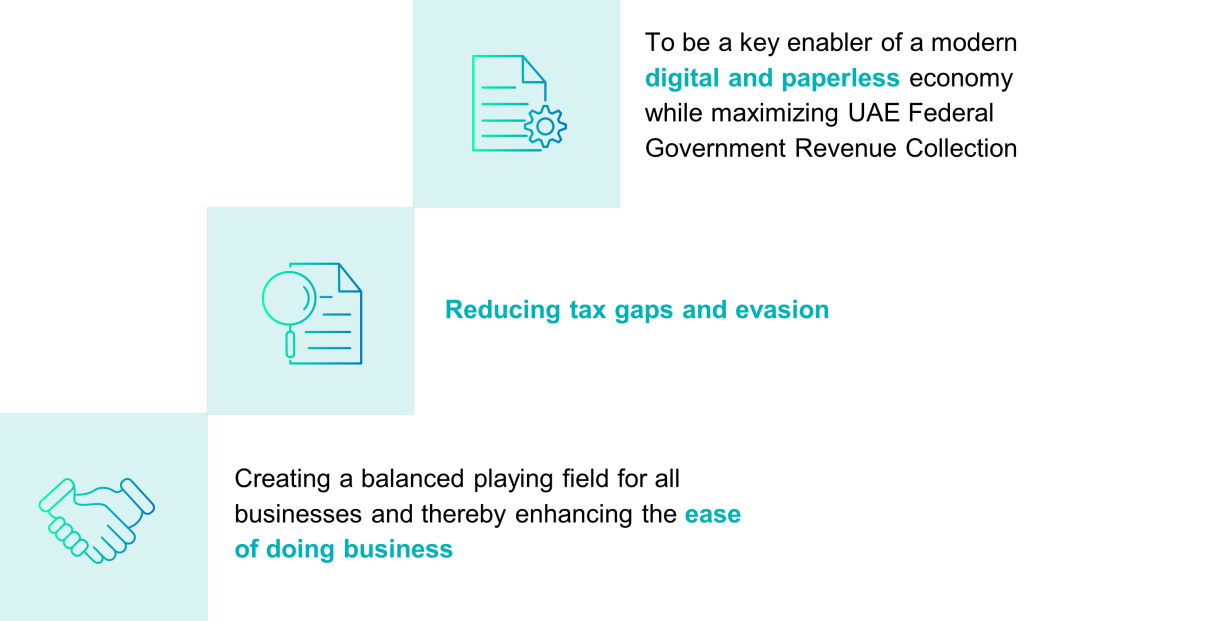
- A modern, paperless economy that also strengthens Federal Government revenue collection.
- Reducing tax gaps and evasion through real-time, verifiable transaction data instead of self-reported totals.
- A more level playing field for compliant businesses, and an easier environment to do business in overall.
What Exactly Is an eInvoice?
This is the single most common point of confusion. A PDF invoice, a scanned paper invoice, or an invoice sent as an image is not an eInvoice under this mandate — even though it is technically "digital."

A true eInvoice is created in a structured data format (XML, per the PINT-AE specification) that software can read and validate automatically, with no manual re-entry. That structure is what allows an ASP to validate it and the FTA to receive verified tax data the moment a transaction happens. In short: an eInvoice is traceable, transparent, validated in real time, and reported directly to the tax authority — a PDF sitting in someone's inbox is none of those things.
Benefits of e-Invoicing
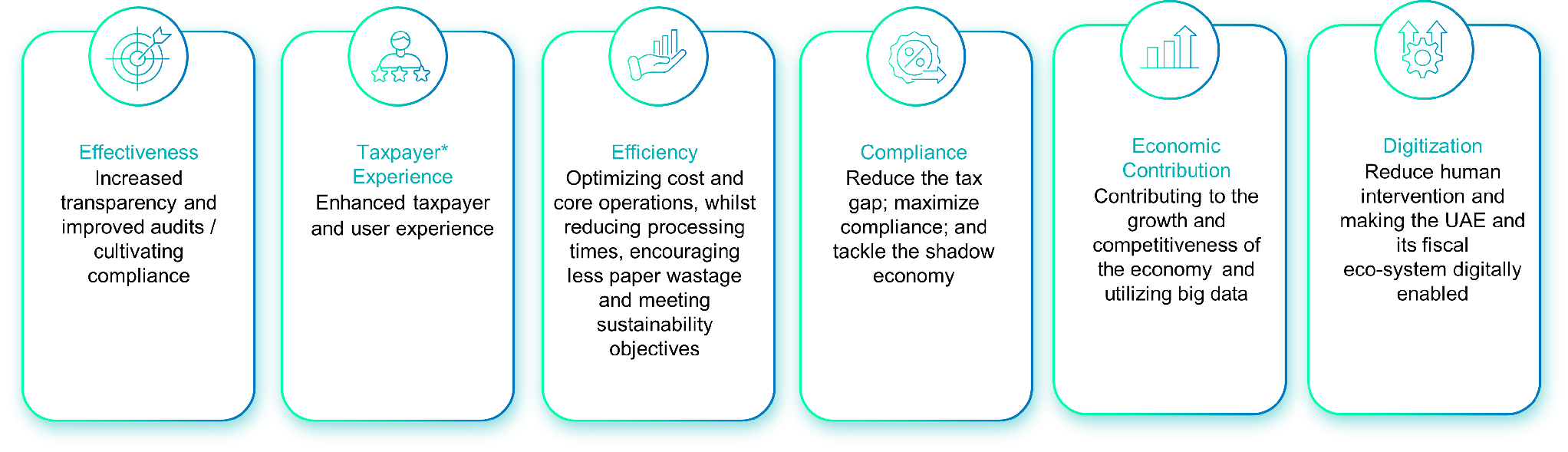
Beyond compliance, structured invoicing tends to speed up payment cycles and reduce disputes, since both sides are validating against the same data. Lower processing costs and fewer manual entry errors are the operational upside businesses notice first.
The Rollout Timeline — Key Dates
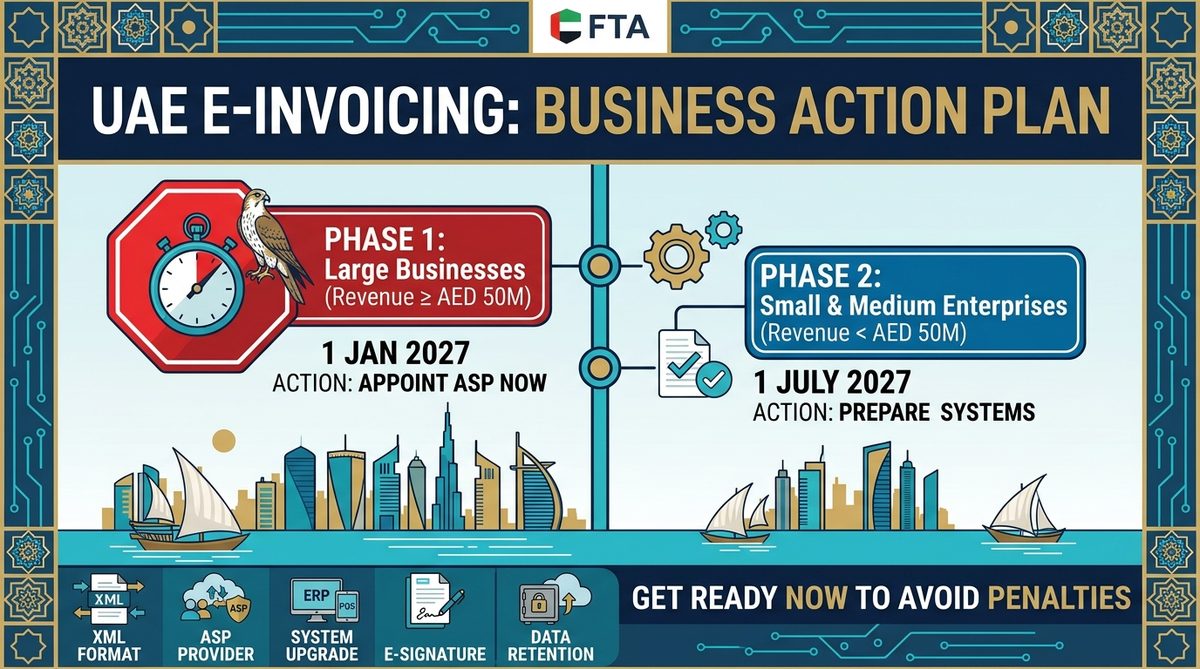
The mandate is phased by business size. These are the dates that matter most:
| Phase | Who It Applies To | ASP Selection Deadline | System Readiness Required |
|---|
| Large Businesses | Revenue > AED 50,000,000 | 30 October 2026 | 1 January 2027 |
| SMEs | Revenue < AED 50,000,000 | 31 March 2027 | 1 July 2027 |
Corner 5 (reporting to the FTA) is already in its pilot phase, and businesses can currently select and onboard with an ASP voluntarily ahead of their mandatory date.
Who Needs to Comply?
Any person or entity making a business transaction in the UAE falls within scope, regardless of VAT registration status. The obligation depends on who is transacting with whom:
| Supplier | Business (Buyer) | Government (Buyer) | Consumer (Buyer) |
|---|
| Business | B2B — Required | B2G — Required | B2C — Not required |
| Government | G2B — Required | G2G — Required | G2C — Not required |
| Consumer | C2B — Not required | C2G — Not required | C2C — Not required |
Excluded from the mandate: sovereign activities, supplies made by airlines, financial services, and any other category the Ministry specifically determines.
How the 5-Corner Peppol Model Works
The UAE has adopted a five-corner model built on the Peppol network, the same global infrastructure used for secure exchange of electronic business documents:
- Corner 1 — Supplier generates the invoice in their accounting or ERP software.
- Corner 2 — Supplier's ASP validates the invoice data and securely transmits it to the buyer's ASP.
- Corner 3 — Buyer's ASP receives and verifies the eInvoice.
- Corner 4 — Buyer receives the eInvoice directly into their own accounting or invoicing system.
- Corner 5 — Ministry of Finance & FTA receives the Tax Data Document reported by both ASPs, in parallel with the invoice exchange, for real-time tax verification.
Mandatory Fields: Where Most ERPs Actually Fail
The PINT-AE specification defines roughly 50 mandatory fields across six groups — invoice details, seller details, buyer details, document totals, tax breakdown, and line items. Most of these map cleanly from standard ERP data. A handful consistently don't, and they're worth checking before you're under deadline pressure:
- Invoice Transaction Type Code — an 8-character flag string covering Free Zone, Deemed Supply, Margin Scheme, Summary Invoice, Continuous Supply, Agent Billing, eCommerce, and Exports scenarios. This is a UAE-specific field with no direct ERP equivalent in most systems — it needs a configuration rule, not just a data mapping.
- Seller & Buyer TRN — must be the full 15-digit Tax Registration Number and must match FTA records exactly. Mismatches on the buyer side can jeopardize their input VAT credit claim, not just yours.
- Seller & Buyer Country Subdivision (Emirate) — frequently missing from customer master data entirely, especially for businesses with operations across multiple Emirates.
- Buyer Electronic Address (Peppol ID) — must be collected from every buyer before you can invoice them electronically. This is the single most operationally challenging field to manage at scale, since it depends on your customers being onboarded too.
- Tax Category Code — the VAT treatment code (Standard, Exempt, Outside Scope, Reverse Charge, Zero Rated, Margin Scheme) at both document and line level. Incorrect codes are a direct audit risk.
- VAT and line amounts in AED — for any invoice not issued in AED, the VAT amount and line totals must still be expressed in AED using the Central Bank rate at the date of supply. This is a real development item for any business invoicing in multiple currencies.
Scenarios Worth Knowing Before You Configure
Advance Payments
If you receive an advance, you must issue a Tax Invoice for that advance at the time of receipt — then invoice only the remaining balance on the final invoice, not the full contract value.
| Stage | Example (Contract: AED 10,000 + 5% VAT) | Invoice Value |
|---|
| Advance Received | Customer pays AED 1,000 + AED 50 VAT | AED 1,050 |
| Goods/Services Delivered | Remaining AED 9,000 + AED 450 VAT | AED 9,450 |
The final invoice should reference the advance invoice's number and date, or note it explicitly.
Reverse Charge Mechanism
| Scenario | eInvoice Required? | Key Requirement |
|---|
| Imported goods/services under RCM | No | No eInvoice needed for imports under reverse charge. |
| Domestic Reverse Charge (specified goods between two VAT-registered businesses) | Yes | Issue an eInvoice without charging VAT, with a note that RCM applies and which goods category triggered it. |
Domestic reverse charge currently covers: electronic devices, precious metals and stones, crude or refined oil, natural gas, pure hydrocarbons, and metal scrap.
Free Zone Transactions
Where a Free Zone entity is involved as supplier, buyer, or ultimate beneficiary, you may need to record a separate "Beneficiary" alongside the "Customer" — the beneficiary being whoever ultimately uses or owns the supply, which isn't always the same party issuing the purchase order.
Penalties for Non-Compliance
The FTA has published a specific administrative penalty schedule. These are worth building into your business case for getting ready early rather than at the deadline:
| Violation | Penalty |
|---|
| Failing to implement e-Invoicing / appoint an ASP within the required timeline | AED 5,000 per month (or part) of delay |
| Failing to issue and transmit an eInvoice on time | AED 100 per invoice, up to AED 5,000/month |
| Failing to issue and transmit an electronic Credit Note on time | AED 100 per note, up to AED 5,000/month |
| Issuer fails to notify the Authority of a system failure | AED 1,000 per day of delay |
| Recipient fails to notify the Authority of a system failure | AED 1,000 per day of delay |
| Failing to notify your ASP of registered data changes on time | AED 1,000 per day of delay |
A Practical Implementation Roadmap
Regardless of which accounting or ERP platform you run today, the sequence that actually works looks like this:
- Assessment & gap analysis. Review turnover, transaction volumes, existing customizations, and which special scenarios apply to you (Free Zone, Reverse Charge, Exports, Summary Invoicing).
- Master data cleanup. Update company and customer/supplier records against actual VAT certificates — TRN, registered address, Emirate, registration type. This is consistently the slowest step and the one most worth starting early.
- System readiness. Confirm your accounting/ERP platform supports PINT-AE structured invoicing, or plan the upgrade/integration needed to get there.
- ASP selection & onboarding. Register through EmaraTax, select an Accredited Service Provider, and complete entity verification — this generates your Peppol Participant Identifier.
- Configuration. Set up voucher numbering, tax category mappings, transaction type flags, and print/export formats for invoices, credit notes, and debit notes.
- Training & pilot testing. Walk your team through the full lifecycle — create, validate, transmit, receive acknowledgement — and run supplier-to-buyer test transactions before go-live.
- Go-live with hypercare support. Monitor early transactions closely and resolve issues fast; most rejection patterns show up in the first two weeks.
How SysVera Helps
As a certified Zoho partner working across Zoho Books, Odoo, SAP, and Dynamics 365 implementations, we run this exact eInvoicing readiness process for clients ahead of their mandatory date — gap analysis, master data cleanup, ASP-ready configuration, and staff training, so the switch to structured invoicing doesn't disrupt how your finance team already works. If you're not yet sure where your current setup stands against the 2026/2027 deadlines, that's exactly the kind of gap worth closing now rather than during crunch season.
This article is for informational purposes only and isn't official tax or legal guidance. Requirements and dates are subject to change — always confirm current requirements directly with the UAE Ministry of Finance and Federal Tax Authority.
Not sure where to start?
Tell us your setup — we'll map the right next step for your business.
Get In Touch →