Turn disconnected business data into reliable information that helps your team make faster, better decisions.
6 min read·SysVera Insights
Your business is already generating valuable data every day — sales, customers, invoices, inventory, finance, operations, and more. The challenge is that this information often lives across different systems, spreadsheets, and databases.
For small and medium businesses, data engineering is about bringing that information together so it can be trusted, understood, and used to make better business decisions.
What Is Data Engineering?
In simple terms, data engineering is the process of connecting, organizing, transforming, and preparing business data so it can be used effectively for reporting, analytics, and business intelligence.
Think of it as the foundation behind your dashboards. A great dashboard is only useful when the data behind it is accurate, consistent, and up to date.
The Data Challenge for SMBs
As businesses grow, they naturally add more systems. You may have a CRM for customers, an ERP for operations, accounting software for finance, spreadsheets for reporting, and other applications for sales and marketing.
Each system may work well on its own. The problem starts when management needs answers that require information from several systems.
Questions such as Which customers are most profitable?, Why are margins changing?, or Which products are performing best? can quickly turn into hours of manual spreadsheet work.
From Data Silos to One View of the Business
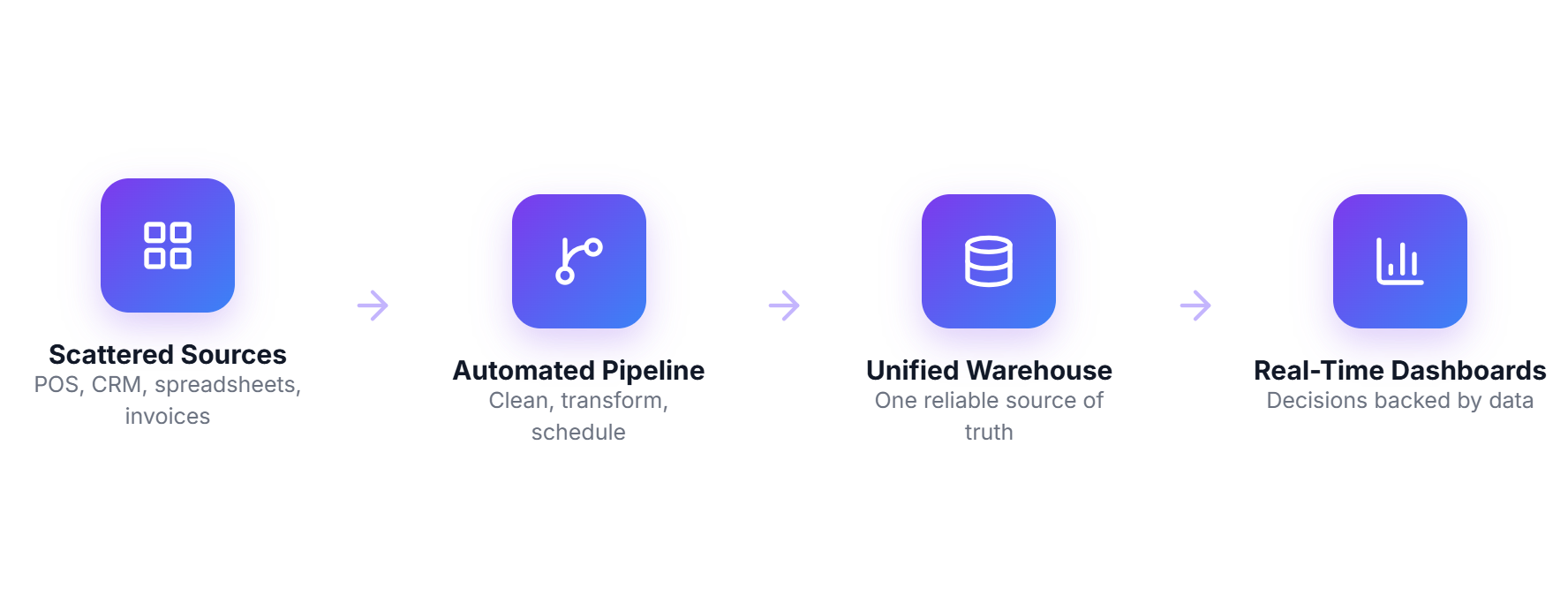
Data integration brings information from different systems together and creates a more consistent view of the business.
Business System
Typical Data
CRM
Customers, leads, opportunities, sales
ERP
Orders, inventory, operations
Accounting
Revenue, expenses, receivables
Spreadsheets
Operational and management data
BI Platform
KPIs, dashboards, business insights
When these sources are connected properly, your team can spend less time preparing reports and more time understanding what the numbers are telling you.
Data Engineering Is More Than Dashboards
Buying a BI tool does not automatically make a business data-driven. The quality of the dashboard depends on the quality of the data behind it.
A practical data engineering approach typically includes:
Connecting CRM, ERP, accounting, databases, and other business systems.
Cleaning and standardizing inconsistent or duplicate data.
Creating reliable data models around your business processes.
Automating data flows and recurring reporting.
Preparing trusted data for Power BI, Tableau, Amazon QuickSight, or other analytics platforms.
How SysVera Helps
At SysVera, we help businesses build practical data foundations without unnecessary complexity.
We can connect systems such as Zoho, Odoo, SQL databases, Excel, and other business applications, then structure the data so it can support reliable reporting and business intelligence.
Our approach is simple: understand the business problem first, build the data foundation second, and then deliver the analytics that help your team make better decisions.
You Do Not Need a Large Data Team
Becoming data-driven does not mean building a large data department or investing in a complicated enterprise platform.
For an SMB, the journey can start with one important business problem. Connect your CRM and ERP. Automate management reporting. Create a trusted sales or finance dashboard. Then expand as your business and data requirements grow.
The goal is not to collect more data. The goal is to make the data you already have more useful.
Signs Your Business Is Ready for This
A few common signals that disconnected data is already costing you time: management asks for a number and it takes more than a day to produce reliably. Two departments report different figures for the same metric. Someone on your team spends a recurring chunk of every week manually copying data between systems. Decisions get delayed because nobody trusts which spreadsheet is the current one. If two or more of these sound familiar, the return on fixing the data foundation usually outweighs the effort involved.
A Realistic First 90 Days
Trying to connect everything at once is how these projects stall. A more realistic path: in the first month, pick one business question that currently takes too long to answer — often something in sales or cash flow — and connect just the systems needed to answer it. In the second month, automate the reporting around that one question so it updates on its own instead of being rebuilt manually. By the third month, with that first win in place and trusted, expand to the next priority area. This staged approach builds internal confidence in the data before asking the business to rely on it more broadly.
Turn Your Data Into a Business Advantage
Your business data should help you understand customers, improve operations, control costs, identify opportunities, and make better decisions.
At SysVera, we help small and medium businesses connect their data, simplify reporting, and build the foundation for becoming more data-driven.
You may already have the data. The next step is making it work for your business.
Not sure where to start?
Tell us your setup — we'll map the right next step for your business.